XCMG vs Zoomlion: Which Used 35-Ton Truck Crane Breaks Down Less? (QY35K5 vs ZTC350H)
Quick Answer: Neither brand publishes third-party failure-rate statistics, and failure risk in used cranes is driven by the unit's history, not the badge — a rental-fleet machine worked hard for three years carries more risk than an owner-operated unit of either brand. What the brand does decide is platform maturity, parts depth, and design intent. The XCMG QY35K5 platform is older, hugely numerous, with the cheapest and easiest-to-find parts; the Zoomlion ZTC350H series is the 2021-generation platform with a 44 m boom, 1,568 kN·m moment and 7.3 m outrigger span — and a maker's claim of 30% longer mean time between failures (self-reported, not third-party). Rule: pick Zoomlion when the work needs 40 m+ reach and stability; pick XCMG when budget is tight, self-repair is routine, and parts availability matters most.
Key Takeaways
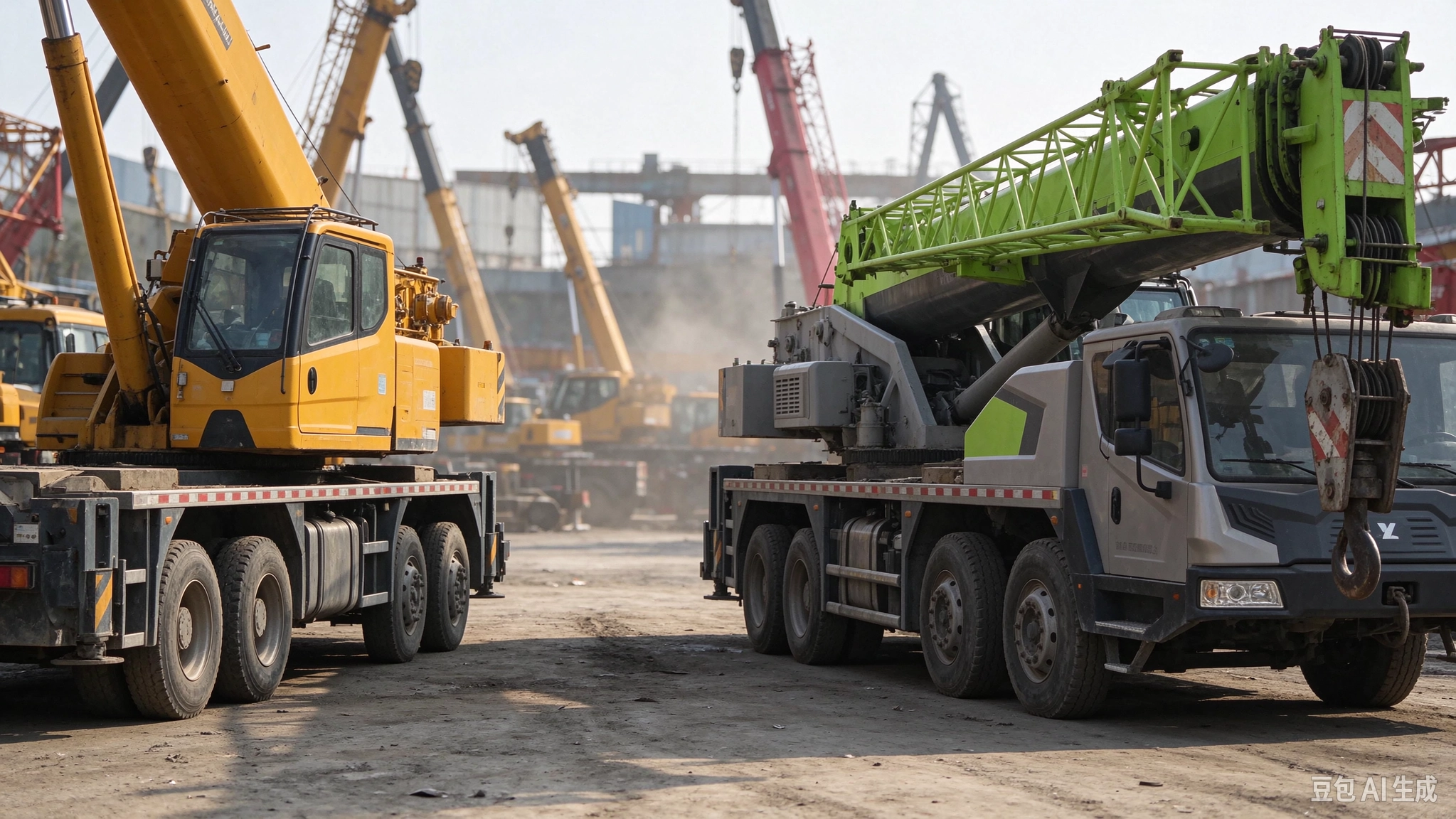
• On paper the Zoomlion ZTC350H562 leads everywhere: base-boom moment 1,568 kN·m (XCMG QY35K5: 1,200), boom 44 m (39.6 m), outrigger span 7.3 m (6.0 m), travel mass 39 t (36.9 t) — a "50-ton performance at a 35-ton price" design, at a heavier and pricier machine.
• The used market prices this in: a 2021 ZTC350H562 lists at CNY 368,800–415,000 incl. transfer (≈ USD 51,900–58,500), while a 2019 QY35K5 at ~6,000 h lists at CNY 310,000 (≈ USD 43,700) — the premium buys 4.4 m more boom and 1.3 m more outrigger span.
• The fair way to compare "failure rate": common failure modes, parts supply, and platform-proven time — not percentage claims with no source. Both platforms fail in the same five places, and the same inspection sheet applies to both.
• Parts favor XCMG: enormous fleet population, mature aftermarket, county-town mechanics know the platform; Zoomlion's newer platform has longer parts cycles but a remote telematics platform that pushes fault codes.
• Resale runs differently: older XCMG units turn over fast and depreciate gently; near-new Zoomlion units hold value well on boom demand, but thin used supply makes individual listings unreliable as a market benchmark.
How do the two 35-ton platforms differ — and what does it mean for a used buyer?
The 35-ton class sits between "more than a 25-ton" and "less than a 50-ton": factory equipment installation, bridge-girder lifting, municipal work. The two brands took visibly different routes here. XCMG's QY35K5 is a mature platform sold for over a decade (the later QY35K5C-1 stretched the boom to 44 m); Zoomlion's ZTC350H552/562 is a 2021 performance-crossing product. Understanding this difference tells you what jobs the machine can take — and which parts wear faster.Table 1. Factory specifications — XCMG QY35K5 vs Zoomlion ZTC350H562 (manufacturer-published data)
Specification | XCMG QY35K5 | Zoomlion ZTC350H562 | What it means for a used buyer |
|---|---|---|---|
Max rated capacity | 35 t at 3 m radius | 35 t | Equal; Zoomlion claims 50-ton-class mid-boom ability |
Base-boom lifting moment | 1,200 kN·m | 1,568 kN·m | Zoomlion ~30% stronger at short radius |
Full-extension moment | — | 940.8 kN·m | The base for long-boom work |
Boom length | 10.5–39.6 m (C variant: 44 m) | 44 m | Longer boom = more rope/sheave wear points in the telescope system |
Boom + jib | 54.6 m (C variant: 60.5 m) | 60 m | Near-equal height coverage |
Outrigger span (long. × lat.) | 5.35 × 6.0 m | 5.95 × 7.3 m (two-stage legs) | Wider = more stable, but needs more yard space |
Travel mass | 36,930 kg | 39,000 kg (+ 1.5 t auxiliary counterweight) | Heavier machine — higher axle loads, slightly costlier transport |
Engine | SDEC SC9DK320Q3, 235 kW | Weichai 228 kW (E variant: WP9H310) | Both mainstream; parts for either are easy |
Max road speed | 75 km/h | 85 km/h (Class-G chassis) | Zoomlion transfers and site access better |
Market entry | early 2010s (K5) | 2021 (H series) | Proven-time vs newer design — different failure logic |
Read the table in one line: Zoomlion bought reach and stability with weight and price; XCMG sells "good enough, cheaper, repairable anywhere." Neither is wrong — a lifting contractor doing city equipment installs is buying production capacity with the Zoomlion's boom and span; an owner-operator running county jobs and servicing his own machine is buying the XCMG's parts network.
How can "failure rate" be compared fairly?
State the fact first: neither maker publishes comparable third-party failure-rate data. Zoomlion says the ZTC350H552's mean time between failures improved 30% — a self-reported comparison against its own previous generation, not against XCMG, and not third-party audited. Anyone quoting "XCMG fails at X%, Zoomlion at Y%" has no source.Three things can be compared honestly:
1. Platform-proven time. The QY35K5 sold for over a decade, so early design weaknesses surfaced and were fixed — one reason older units are cheap. The H series is a 2021 platform that passed the maker's 10,000-cycle simulated-duty fatigue testing (self-reported) but has only a few years of market exposure. Buying a pre-2019 XCMG means buying a known-issue list; buying a post-2021 Zoomlion means buying newer design and remaining test life.
2. Common failure modes and parts supply. At this tonnage, failures cluster in five areas; the modes are the same for both brands, and the difference is parts availability and price (Table 2).
3. The individual unit's history. The real failure-risk ranking is: usage intensity > maintenance records > age > brand. A rental-fleet hand-back and an owner-operated unit of the same brand, year and hours are not the same risk class.
Table 2. Common 35-ton failure modes and parts supply — shared patterns, platform differences
Failure area | Typical symptom | XCMG QY35K5 platform | Zoomlion ZTC350H platform |
|---|---|---|---|
Boom telescope system | Slack/frayed telescoping ropes, sheave wear, section play | Large aftermarket for ropes and sheaves; cheap and stocked | OEM parts dominate, cycles slightly longer; 44 m boom means longer ropes and more checkpoints |
Slewing bearing & gearbox | Play, noise, tooth pitting | Huge fleet → salvage and repaired parts circulate | Thin salvage pool on a new platform; mostly new-part replacement |
Main pump / control valves | Case-drain growth, weak motion, internal leakage | SDEC + established hydraulics; every shop knows it | Kawasaki-type pumps by batch; fewer specialist shops |
Outrigger holding valves & cylinders | Sink under hold, stuck lock valves | Generic parts, cheap repairs | Two-stage legs add structure and shop hours |
Moment limiter / sensors | Display drift, dead alarm, false alarm | Big fleet → many calibration points | Telematics platform reads fault codes remotely — faster diagnosis |
Parts-cycle field figures (verify per order): XCMG common parts same-day to a few days; Zoomlion common parts a few days to about a week; rare items wait for factory scheduling on both. And note the trap: Zoomlion's telematics make faults found faster — that is not the same as faults happening less.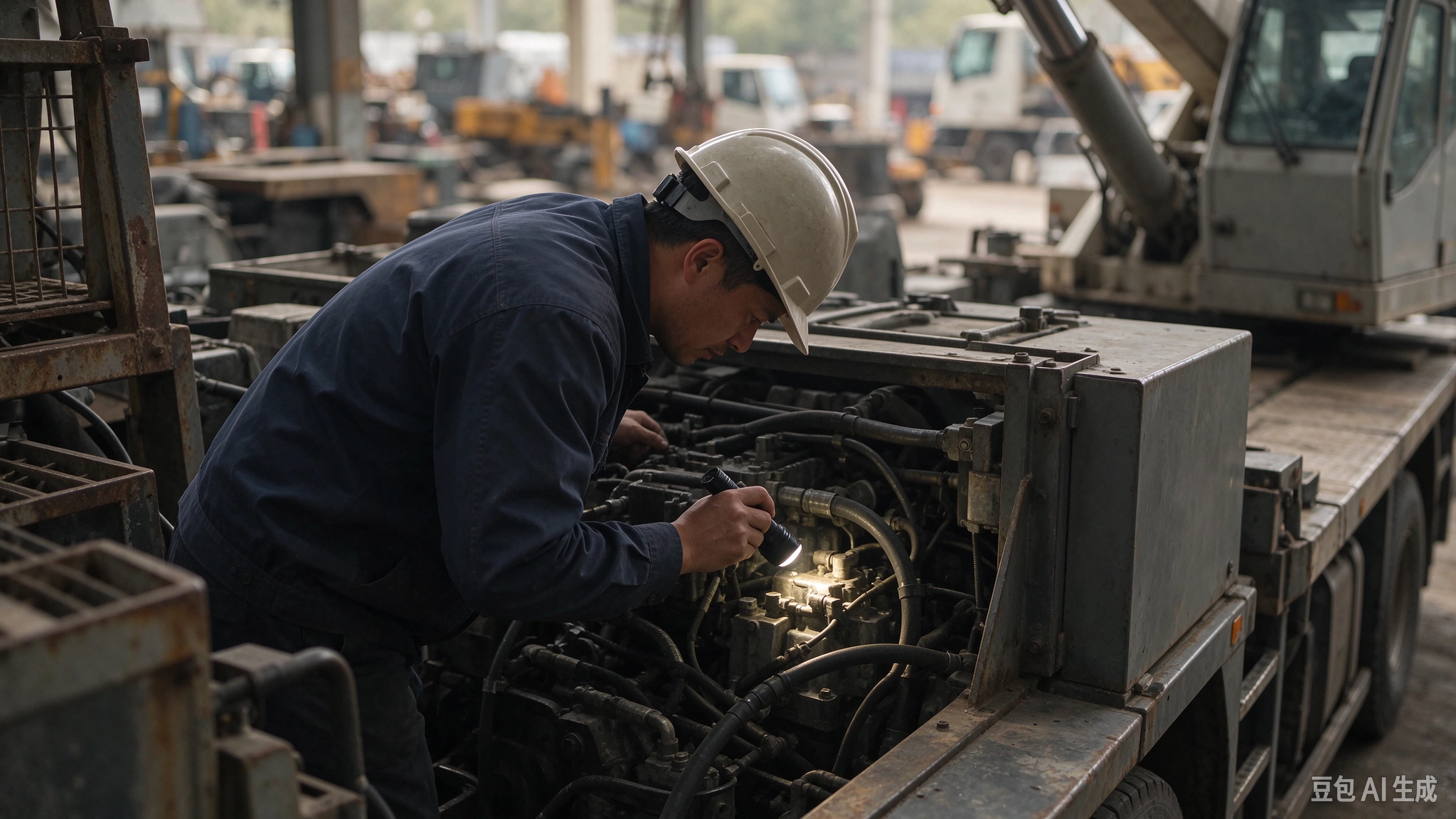
What do used prices and resale look like — with the conditions each number needs?
2026 listing examples (all seller-stated; verify per unit):• XCMG QY35K5, Sept 2019, ~6,000 h, 20,000 km: CNY 310,000 (≈ USD 43,700) — holds if China-V emission, original condition, one owner.
• XCMG 35K5, Oct 2013: CNY 140,000 — holds if no accidents, no welding, emission and registration acceptable to the destination policy.
• XCMG China-IV 35K5 band: CNY 300,000–500,000 (cehome market note) — landing point set by year, hours and counterweight completeness.
• Zoomlion ZTC350H562, 2021, ~1,000–1,500 h: CNY 368,800–415,000 incl. transfer (≈ USD 51,900–58,500) — holds if original paint, one owner, valid inspection and insurance.
• Zoomlion ZTC350H562, 2019, 5,630 h: CNY 330,000 (≈ USD 46,500) — holds if China-V, transfer included.
• Export reference: 2021 ZTC350H5 listed at USD 67,000 EXW China — holds for the 44 m five-section boom + 16 m jib; add freight and compliance for export buyers.
Resale logic: old XCMG platforms turn over fast — buy cheap, sell fast, gentle depreciation while you hold. Near-new Zoomlion H units hold value on 44 m boom demand, but thin used supply means one high listing is not a market. What moves your P&L more than "failure rate" is the condition risk already baked into your purchase price — inspect and deduct per the methods in our on-site inspection guide: 12 critical points; the same sheet applies to both brands.
Common pitfalls — and who carries the risk?
• "Lower failure rate" as a sales pitch. When a seller claims one brand "never breaks," ask for a verifiable source. Table 2's failure modes exist on both. Risk boundary: unit condition is the seller's disclosure duty — not the brand's.
• Same year ≠ same condition. A CNY 310,000 XCMG and a CNY 330,000 Zoomlion from 2019 are not "the same spec, CNY 20,000 apart" — align hours, counterweight count and boom sections first.
• Underestimating parts cost. Telescope ropes and sheave sets are consumables on long-boom machines; the 44 m boom has longer ropes and more checkpoints than the 39.6 m — put that in the ownership budget for a Zoomlion.
• Emission and registration. Sub-China-V units face transfer restrictions in many regions; confirm the destination's import standard before committing. Buyer's duty.
• Overtrusting telematics. Fault-code push is not maintenance-free — the platform reports faults that already happened; handbook schedules still prevent them.
Responsibility boundaries: the seller discloses condition truthfully (accidents, welding, flooding, true hours) and delivers complete paperwork; the buyer handles emission compliance, transfer confirmation, payment and transport. Every inspection finding goes into a contract annex before money moves.
How we made this comparison
Specifications come from the two makers' public channels (XCMG QY35K5 cross-checked via d1cm.com and Baidu Baike; Zoomlion ZTC350H562 via lmjx.net and Zoomlion official releases). Prices are 2026 domestic used-platform listings, each with its stated conditions. Failure modes are derived from shared 35-ton truck-crane architecture plus each platform's configuration differences (telescope system, outrigger structure, powertrain) — no unsourced failure-rate percentages are used. Listing prices move with the market; re-verify per unit. This article takes no brand position and is not a purchase commitment.FAQ
Zoomlion claims 30% better MTBF — does that mean 30% fewer failures than XCMG?No. It is a maker-reported comparison against Zoomlion's own previous generation — not a cross-brand comparison and not third-party audited. It shows the H series invested in reliability design; it does not convert into a brand-gap number.
With a CNY 300,000-odd budget: 2019 XCMG or 2019 Zoomlion?
Compare condition before brand. At matched year and hours the price gap is usually ~CNY 20,000 — and that buys the 44 m boom and 7.3 m span. If long-radius work dominates your jobs, Zoomlion; if your work stays under 30 m, the XCMG's savings are your profit.
The QY35K5C-1 and the Zoomlion H both have 44 m booms — how do I choose?
Check that a listing marked "QY35K5C" really is the C variant — verify boom sections and nameplate on the actual unit. With boom length equal, compare outrigger span (Zoomlion's 7.3 m two-stage legs lead) and price.
What is the single most expensive repair on a 35-ton crane?
The main hydraulic pump and the boom telescope system. Pumps run CNY 30,000–80,000 by model; a full rope-and-sheave set is thousands to CNY 20,000. Run a holding test and full telescope test before buying so that risk is priced in.
For export buyers of either brand, what about parts?
XCMG's global service network and aftermarket ecosystem are deeper — easier self-sourced parts abroad. Zoomlion's telematics support remote diagnosis, best when a service station exists in the destination country. Either way, ship consumables (rope sets, filters, seals) with the machine.
Sources
• XCMG QY35K5 specifications (catalogued by d1cm.com): https://m.d1cm.com/product/xcmg001/100093/canshu
• Zoomlion ZTC350H552 official product page (MTBF +30% claim and test protocol): https://www.zoomlion.com/content/details18_1220.html
• Zoomlion ZTC350H562 specifications (lmjx.net): https://www.lmjx.net/d/zoomlion_qicheqizhongji/ztc350h5621/
• Used listings: XCMG 35 t 2019 at CNY 310,000 (gongji58.com): https://dxe.gongji58.com/sale/1027347.html ; Zoomlion ZTC350H562 2019 at CNY 330,000 and 2021 at CNY 368,800–415,000 (gongji58.com): https://dxe.gongji58.com/sale/1185051.html , https://dxe.gongji58.com/sale/1075748.html
• Export listing: 2021 Zoomlion ZTC350H5 at USD 67,000 EXW (dindang168.com): https://en.dindang168.com/app/home/productDetail/105044
• XCMG China-IV 35K5 used price band (cehome.com market note): https://hangye.cehome.com/2331374.html
Published: 2026‑11‑19
Last reviewed: 2026‑11‑19
Author: 【Flora He 】Equipment Inspector, FairTradeMachinery






 Live Chat On Whatsapp Now


 FAQs
 WhatsApp